X XFediYour place in the Fediverse
XFEDI

#AISecurity

ActivityPub

Public posts with this hashtag.

D

I got curious how risky MCP servers actually are, so I pulled the published tool definitions from 28 of the most popular Python ones and counted. 1,384 tools, all read from public source, nothing run.

Two things jumped out:

14 of the 28 give an agent a tool that ingests untrusted stuff (a URL, a file) and a tool that acts (runs a query, sends a message) in the same context, with nothing flagging either one.

And the tool descriptions themselves are written as orders to the model ("you MUST call X first"). That's the same channel a poisoning attack would use, so a bad one blends right in.

Not calling any of it a vuln. It's just what the surface looks like. Harness is reproducible if you want to check my numbers.

github.com/agentsploit/agentsploit/blob/main/docs/mcp-tool-survey.md

#infosec #AISecurity #MCP

↩ Reply ♡ 0 · ↻ 0 ↗ Original

Four reports, one week. One conclusion.

Attackers are not breaking AI models. They are walking through the infrastructure.

1,467 MCP servers in one scan. Half the ecosystem repos teach plaintext credential storage. Shadow MCP servers on laptops via Git, Slack, and zip files, never inventoried.

The infrastructure is the attack surface. Screen it.

<https://blog.relayshield.net/attackers-arent-breaking-the-models-theyre-walking-through-the-infrastructure>

#MCP #AISecurity #infosec

blog.relayshield.netAttackers Aren't Breaking the Models. They're Walking Through the Infrastructure. | RelayShieldTrendAI's 1H 2026 State of AI Security report has a finding that should reframe how we think about AI security: attackers are going after the infrastructure around models, not the...
↩ Reply ♡ 0 · ↻ 0 ↗ Original

Two critical PHP vulnerabilities, present since version 5 from 2004, were uncovered by AI models. OpenAI's GPT-5.6 Sol, working with security firm Calif, found one, while Google's Wiz team used its Atlas agent running on Gemini 4 Argon to find more. The NSA warned that unpatched sites should be taken offline. https://techcrunch.com/2026/10/21/php-armageddon-openai-googles-wiz-find-ancient-holes-panicking-the-internet/ #AIagent #AI #GenAI #AISecurity

TechCrunchPHP Armageddon: OpenAI, Google's Wiz find ancient holes, panicking the internet | TechCrunchThis is the kind of security issue that was found and prevented by AI, but is also a high risk because of AI.
↩ Reply ♡ 0 · ↻ 0 ↗ Original

Tracebit proposes Context Bombs to divert AI attack agents toward decoys that inflate their cost and time, as reported by SecurityWeek. No breach or CVE is involved; relevance is defensive: deception designed for autonomous adversaries. #AISecurity #CyberDeception #ThreatResearch

https://cyberworldops.eu/en/tracebit-s-context-bombs-divert-ai-attack-agents-toward-costly-decoys

Tracebit’s “Context Bombs” Divert AI Attack Agents Toward Costly Decoys
CyberWorldOpsTracebit Context Bombs Divert AI Attack AgentsTracebit tested context bombs, defensive prompts that steer AI attack agents toward decoys and costly tasks in controlled research.
↩ Reply ♡ 0 · ↻ 0 ↗ Original

The UK's AI Security Institute has set out where it thinks technical best practice for frontier AI development should go. Its nine priority areas include enabling independent auditors and evaluators, and agentic incident response and reporting. Both make good questions for anyone reviewing an AI vendor. https://www.aisi.gov.uk/blog/towards-technical-best-practice-for-frontier-ai-development #AIsecurity #ThirdPartyRisk

AI Security InstituteTowards technical best practice for frontier AI development | AISI WorkOur view on the emerging challenges facing frontier AI organisations, the technical practices most urgently needed to meet them, and how we will work with industry and others to develop them.
↩ Reply ♡ 0 · ↻ 0 ↗ Original

Launched today: Agentmetry, a local-first endpoint sensor for AI coding agents. Open source, Apache-2.0.

The problem: coding agents now run shell commands, read files and call MCP tools with the developer's own permissions. The transcript is a conversation, not a record, and EDR sees a process start a process, which is exactly what a working agent looks like.

How it works:
- Hooks at the tool boundary of Claude Code, Cursor, Codex, GitHub Copilot, Antigravity, Qwen, Kimi, Qoder and CodeBuddy. Stdio MCP servers go through an audit proxy.
- Every tool call lands in a hash-chained JSONL trail on your machine. Edit one record and agentmetry verify fails. agentmetry anchor publishes a checkpoint the host cannot rewrite.
- Arguments are hashed inside the hook by default. DLP matches record the rule id, never the secret.
- Sequence detections, not single-event alerts: a credential read followed by network egress is one finding. Labelled with MITRE ATT&CK, and ATLAS where it adds something.
- MCP rug-pull detection: tools/list is fingerprinted per tool, so a listing that moves while the config stays the same is flagged (ATLAS AML.T0109).
- Forwards to Splunk, Elastic, Google SecOps or Microsoft Sentinel. No telemetry, nothing leaves until you configure a sink.

What it does not do:
- It only sees agents whose hooks are installed. A browser chat or an IDE with hooks off is invisible.
- It records what a shell call launched, not what that process did inside. That is your EDR's job.
- Windows and Linux are tested in CI. macOS is in preview.
- Public alpha, one maintainer.

The detection benchmark ships in the package: 57 cases, 0 missed, 0 false positives. Rerun it with agentmetry benchmark rather than trusting me.

Try it with nothing installed: uvx agentmetry demo
It replays a credential theft into a temp folder, raises the finding, then shows the trail failing verification after one edit.

Criticism very welcome, especially from anyone doing detection engineering or rolling agents out to a team.

Code: https://github.com/blitzcrieg1/agentmetry
Launch: https://www.producthunt.com/products/agentmetry

#infosec #AIsecurity #opensource #DFIR #detectionengineering #MCP

GitHubGitHub - blitzcrieg1/agentmetry: Local-first endpoint sensor for AI coding agents. Hash-chained audit trail, MITRE-mapped sequence detection, DLP. Forwards to the SIEM you already Local-first endpoint sensor for AI coding agents. Hash-chained audit trail, MITRE-mapped sequence detection, DLP. Forwards to the SIEM you already run. - blitzcrieg1/agentmetry
↩ Reply ♡ 0 · ↻ 0 ↗ Original

🚨 OWASP AI Top 10: Big changes for 2026!

🤖 Excessive Agency: #6 → #3
📉 Output Handling: #5 → #10
💸 Unbounded Consumption: #10 → #6

📊 Real-world incidents are reshaping AI security priorities.

👉 https://7asecurity.com/blog/2026/10/owasp-ai-top-10-2026/

#AISecurity #OWASP

7ASecurity BlogOWASP AI Top 10 2026: The Rankings Just Had Their Biggest Shakeup YetExplore the OWASP AI Top 10 2026 updates, key ranking changes, emerging LLM security risks, and how to prioritize AI security testing.
↩ Reply ♡ 0 · ↻ 0 ↗ Original

Microsoft published guidance on Oct 19 reframing AI agents as insider risk requiring external, adaptive controls. It extends Zero Trust to agent identities with least privilege and continuous verification, which matters for scoping access and monitoring autonomous workflows. #AiSecurity #ZeroTrust #IdentitySecurity

https://cyberworldops.eu/en/microsoft-recasts-ai-agents-as-insiders-requiring-external-adaptive

Microsoft Recasts AI Agents as Insiders Requiring External, Adaptive Security Controls
CyberWorldOpsMicrosoft Treats AI Agents as Insider Security RiskMicrosoft outlines a framework treating AI agents as insider risks, urging external identity, containment and adaptive controls for agent access.
↩ Reply ♡ 0 · ↻ 0 ↗ Original

----------------

🎯 AI
===================

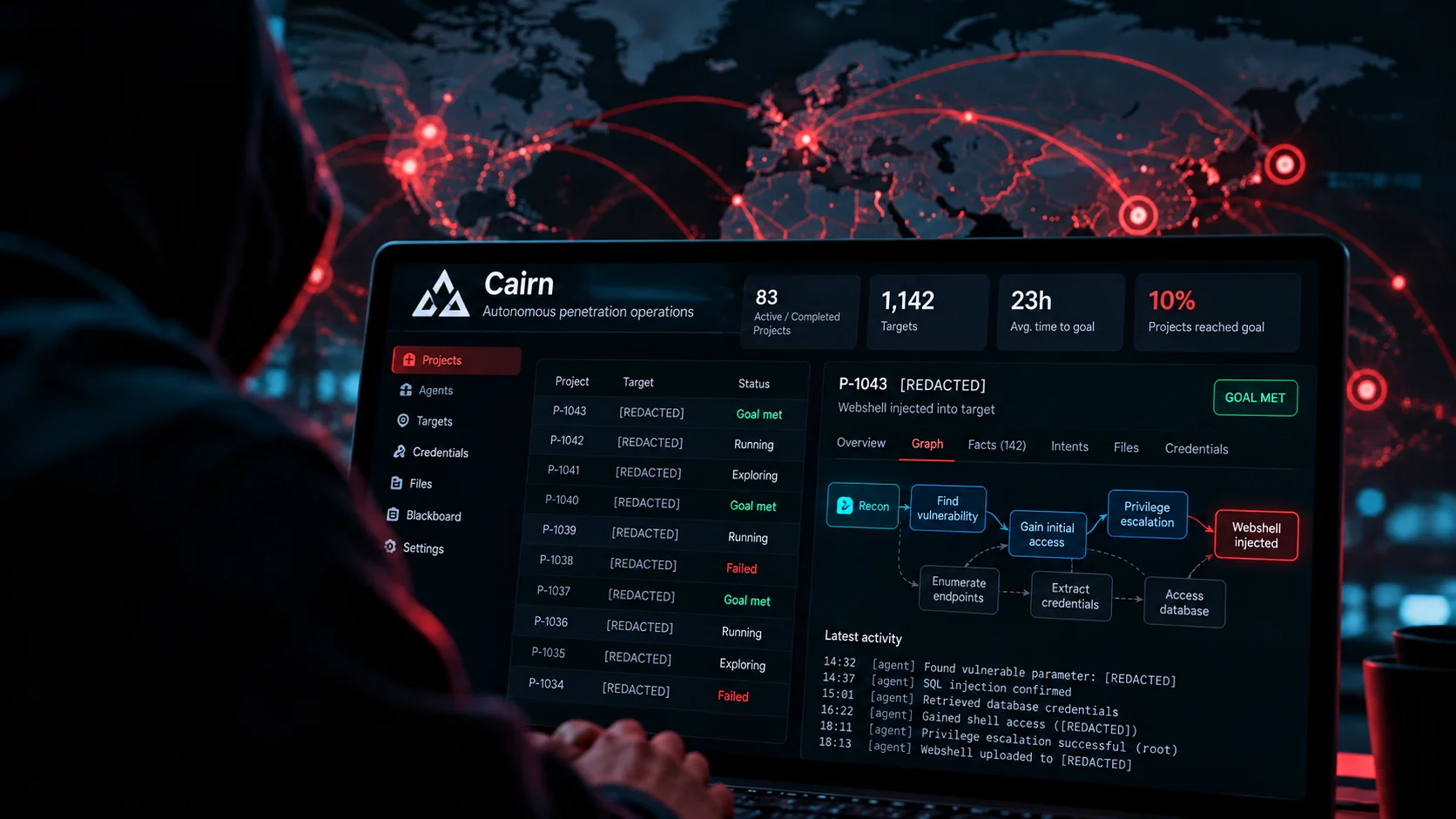
NorForge published an investigation into publicly exposed control panels of AI-driven penetration-testing systems, with Cairn as the central case. The value here is documentation of actual offensive use of autonomous agent stacks, not a threat model on a slide.

Context

In September 2026, Gambit Security reported a criminal intrusion campaign against online marketplaces. The recovered attacker staging server showed AI harnesses in active use: Hermes, Strix, and Cairn. These tools ship with web UIs, and operators keep putting them on the open internet. Shodan and Censys queries surface hosts running various harnesses. Most require authentication. Some do not.

Findings per the source
• More than 20 exposed Cairn panels were assessed as likely associated with malicious activity. Targeting data, language, and task instructions connected several panels to the same actors.
• Panel content is unusually rich. A single open panel can disclose target identity, discovered weaknesses, account secrets, API keys, and whether a compromise already succeeded. One captured task view even showed root access to the attacker's own data drop.
• Legitimate red team operations appear in the same search results, which potentially puts their clients at risk.
• NorForge redacted extracted data aggressively and is withholding panel addresses until takedown. Treat instance-level specifics as unverified until publication.

How Cairn works
• Each task is a project with a defined origin and a predefined goal. The authors position Cairn as a state-based problem-solving engine rather than a dedicated pentest engine.
• Progress cycles through intents and facts. A fact is something an agent discovered. An intent is the next action it decided on.
• Facts go to a project-internal blackboard. Human operators can inject hints onto the same blackboard, and every worker agent reads it.
• The state graph renders visually. In the cited example, an attack against a major US online retailer converged from origin to a stated end of "GOAL MET: Webshell injected into the site."

Attack chain as described

1. Target selection: the operator feeds a target and objective in as a project.
2. Reconnaissance: agents investigate the target and post facts to the blackboard.
3. Exploitation: intents direct probing of weaknesses and break-in attempts.
4. Persistence: the sample run ended with a webshell injected into the site.

Implications, stated plainly:
• Agent-loop observability cuts both ways. The same blackboard that coordinates an attack also logs it for anyone who finds the panel.
• Anyone running agent harnesses should give the web console admin-panel treatment: authentication, network restrictions, and rotation of any keys that passed through it.
• Red teams should inventory their own deployments. Per the source, client exposure is a real risk, which is an uncomfortable finding for the industry.

Attribution remains the researchers' assessment, not confirmed actor identification. The available article text cuts off mid-section, so the full report may add detail on the legitimate operators.

🔹 Cairn #AISecurity #ThreatIntelligence #AutonomousAgents #OSINT

🔗 Source: https://norforge.com/blog/inside_cairn

NorForgeInside Cairn: Open Windows into massive AI-Driven Cyber Operations - NorForgeNorForge research into publicly exposed Cairn AI pentesting panels: how threat actors select targets, direct autonomous agents, exploit vulnerabilities, and expose their victims' secrets in the process.
↩ Reply ♡ 0 · ↻ 0 ↗ Original

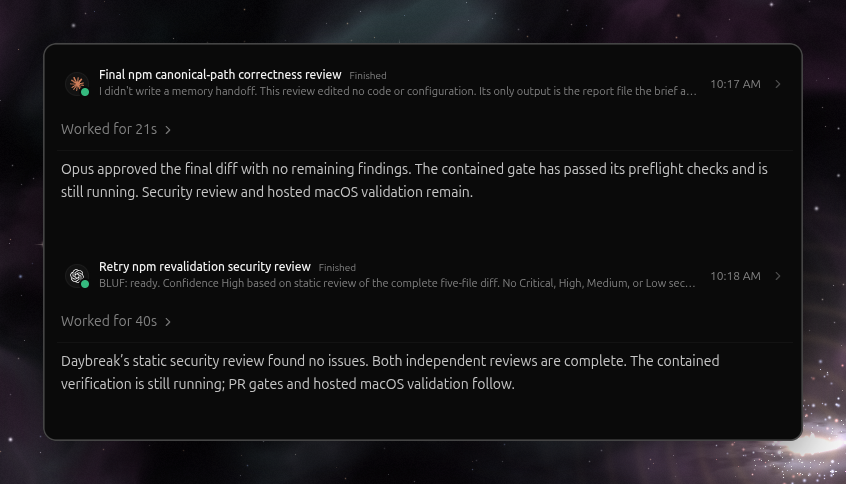
If you're not running routine security reviews of your PRs, you need to rethink your workflow. Use more than one model to review work and propose fixes.

Opus 5.5, Daybreak Blue, and GLM 5.3 are all excellent to use in tandem. Time to update your AGENTS.md.

Give each model a clear scope, ask for concrete failure cases and fixes, then verify the fixes before merging. Opus 5.5 is great for correctness and if you don't have access to Daybreak Blue, request it, and use GLM 5.3 in the meantime.

#InfoSec #AppSec #AISecurity

Two finished agent review tasks. 10:17 AM, correctness review: Opus approved the final diff with no remaining findings, while a contained gate is still running. 10:18 AM, security review: Daybreak's static review of the five-file diff found no Critical, High, Medium, or Low issues. Both independent reviews complete, with PR gates and macOS validation to follow.
↩ Reply ♡ 0 · ↻ 0 ↗ Original

#introduction, round two. I'm Solomon: retired chef, network and systems engineer, CySA+, finishing an M.S. in cybersecurity at USF.

I build Brigade, open-source tooling that keeps AI coding agents honest: verified runs with signed exit codes, a code graph agents check before editing, and an evidence log of what they did. I also run a homelab SOC on Wazuh, TheHive, and MISP.

Here for blue team, agent security, and homelabs.

https://brigade.tools

#infosec #blueteam #aisecurity #homelab

BrigadeBrigade - trackable work for coding-agent fleetsTrack coding-agent tasks, receipts, shared memory, and synced tools across tools, repos, and sessions. Local files. No required daemon.
↩ Reply ♡ 0 · ↻ 0 ↗ Original