X XFediYour place in the Fediverse
XFEDI

#Physics

ActivityPub

Public posts with this hashtag.

↳ In reply to a post

October 22, 2026

The First Green Star, WD J1330+6435
* Credit & Copyright: Mark A. Garlick/University of Warwick
https://markgarlick.com/
https://warwick.ac.uk/
* Text: Cecilia Chirenti

Explanation:
Star light, star bright: is there a green star out tonight? Other than the Sun, all stars are so far from Earth that they appear as points in the sky. They are mostly white, but sometimes noticeably red or blue. This color typically relates to the temperature: blue stars are hotter than red stars. What about other colors? The featured image is an illustration showing WD J1330+6435, a white dwarf star, surrounded by an accretion disk with gas and rocks orbiting the star. White dwarfs are small, faint stars that are left over when a star like the Sun exhausts its nuclear fuel. Astronomers recently found that some white dwarf stars, despite their name, would appear yellow, green, cyan, pink, or purple. In these cases, trace elements that were accreted to these stars interact with the stellar atmosphere and shift its normally white color. But, alas! I wish I may, I wish I might, but they are too faint to see tonight...

https://science.nasa.gov/image-article/apod-2026-october-22-the-first-green-star-wd-j13306435/

#space #dwarfs #giants #astrophotography #photography #science #astronomy #physics #nature #NASA #ESA #education #apod

October 22, 2026 
A star shines with a greenish hue in front of a dark field with more distant stars, surrounded by a greenish disk with debris.

The First Green Star, WD J1330+6435
 * Credit & Copyright: Mark A. Garlick/University of Warwick

Explanation: 
Star light, star bright: is there a green star out tonight? Other than the Sun, all stars are so far from Earth that they appear as points in the sky. They are mostly white, but sometimes noticeably red or blue. This color typically relates t
MarkGarlick.comHome | MarkGarlick.comOnline gallery of space and astronomical illustration and animation
↩ Reply ♡ 0 · ↻ 0 ↗ Original
↳ In reply to a post

"A Fan-tastic Sign From Heaven"

October 20, 2026

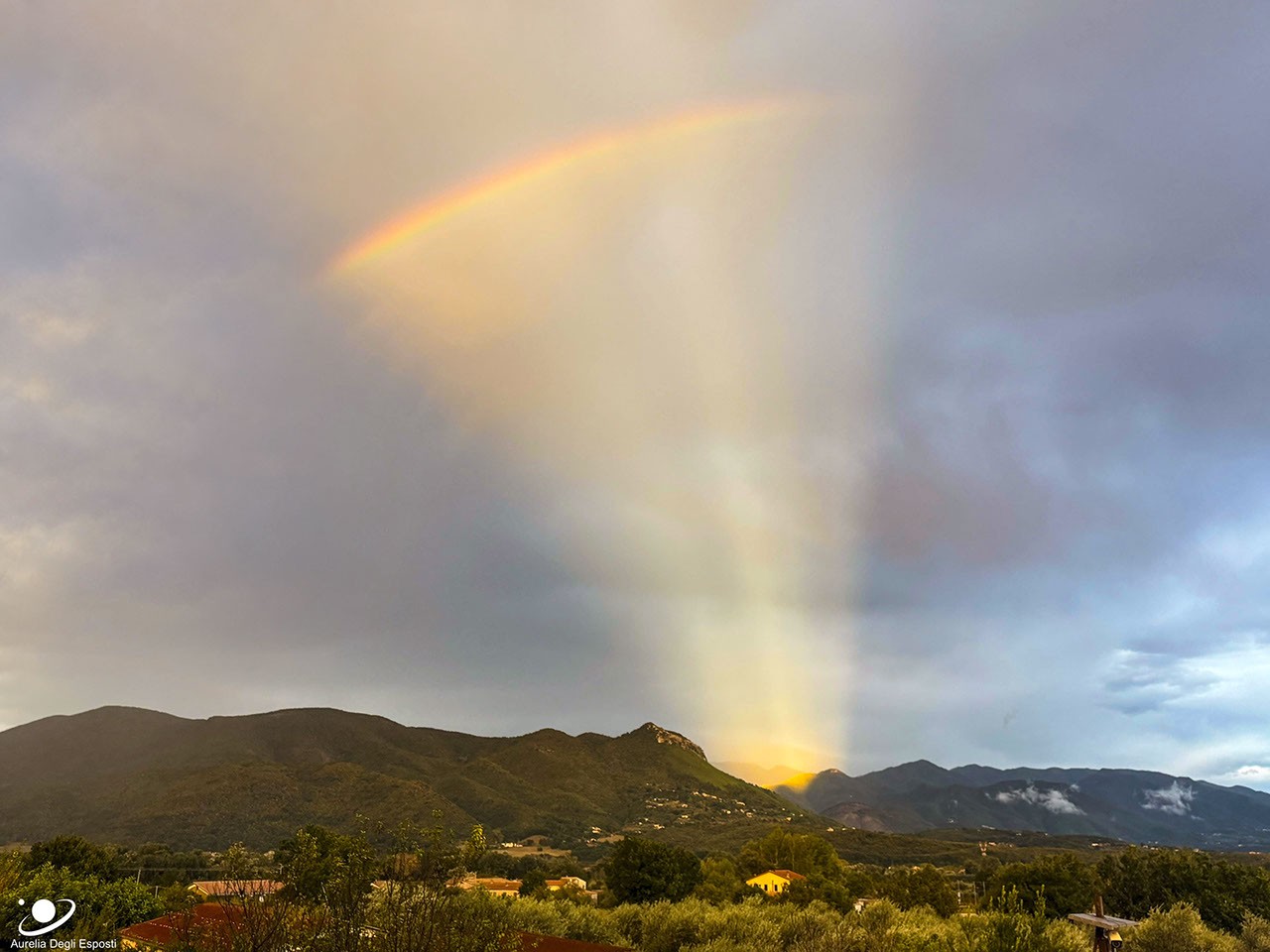
An Anticrepuscular Rainbow Fan
* Credit & Copyright: Aurelia Degli Esposti

Explanation:
This is an unusual rainbow. For one thing, the rainbow is not complete, appearing only in a sunlit fan -- but that by itself is not very unusual. What is most unusual is the fake location of the Sun. The Sun appears to be toward the front, just below those hills -- but it is not. That is not how rainbows work. Rainbows involve a backward reflection from falling rain, so that the Sun must really be behind you. In this case, gaps between clouds near the setting Sun allowed rays to cross the entire sky and appear to converge in front, an unusual phenomenon called anticrepuscular rays. The photo was taken with a phone last week at sunset in Presenzano, Italy. The seemingly reverse rainbow was noticed when hanging up laundry.

https://science.nasa.gov/image-article/apod-2026-october-20-an-anticrepuscular-rainbow-fan/

#space #earth #rainbow #anticrepuscular #sun #astrophotography #photography #NASA #science #physics #nature #apod

October 20, 2026 
Hills are seen in the distance below a partly cloudy sky. A group of orange rays appears to eminate from one area behind the hills. Across this fan of rays, near the top of the image, a short rainbow can be seen

An Anticrepuscular Rainbow Fan
 * Credit & Copyright: Aurelia Degli Esposti

Explanation:
 This is an unusual rainbow. For one thing, the rainbow is not complete, appearing only in a sunlit fan -- but that by itself is not very unusual. What is most unusual is the fake
NASA ScienceAPOD: 2026 October 20 - An Anticrepuscular Rainbow Fan - NASA Science
↩ Reply ♡ 0 · ↻ 0 ↗ Original