

Monday: While the world’s major cities are still debating what format of peace talks would suit Putin best, Russia has devastated Kharkiv. The city suffered two major strikes in a single day. Overnight, Banderol jet drones struck the city in a classic “double-tap” attack, in which the second strike targets the area where people and firefighters have already gathered. The attack left one person dead and eight injured; at least ten multi-story buildings were damaged, and an office building and cars were on fire. Around 2:40 p.m., three guided aerial bombs struck the Slobidsky district, hitting a five-story residential building, the DBN company—which manufactures drywall panels for the reconstruction of destroyed buildings—and a tailor’s workshop. According to Oleg Synehubov, head of the Kharkiv Regional Administration, the afternoon airstrike left six people dead and fifty-nine injured, including three children. An 11-year-old girl is in critical condition. Rescue service spokesperson Yevhen Vasylenko reported that two people were pulled alive from the rubble. Mayor Ihor Terechov, however, warned that there may be others still trapped beneath the debris. It is worth noting that Putin and his propaganda machine consider Kharkiv a “Russian city.” And this also happened:
- Ukrainian drone strikes have already taken out more than 51 percent of Russia’s oil processing capacity. In mid-September, that figure stood at 45 percent. Defense Minister Yevhen Khmara described this as a significant blow to the enemy’s economy and its ability to wage aggression and supply its military units. According to the International Energy Agency, Russian production fell to 3.8 million barrels per day in June—the lowest level in twenty years—and by mid-September, 204 strikes on 28 major refineries had been confirmed. Repairs to secondary units take six to eight months. A Moscow refinery with a capacity of 250,000 barrels per day is expected to remain out of operation until early 2027. In addition, Ukraine has tripled its production and purchases of long-range drones this year. On September 28, Putin signed a decree restricting the publication of data on the status of refineries.
- Overnight, Russia launched more than 205 attack drones at Ukraine. By 8:00 a.m., air defenses had shot down or neutralized 172 of them; strikes were recorded at thirteen locations, and debris fell at three others. In the Sumy region, 45 strikes on 21 communities left one person dead and several injured; in Mykolaiv, a Banderol missile damaged warehouses and vehicles and injured one person; in the Dnipropetrovsk region, nearly fifty drone and artillery strikes across three districts left one person dead and one injured. In Sloviansk, three airstrikes killed one person and injured three others, including a child.
- Russian drones attacked the cargo ship Royad Mammadov, sailing under the flag of Saint Kitts and Nevis and owned by the Turkish company MG Shipping 5, in the Black Sea. It was carrying corn from Izmail, Ukraine, to Ravenna, Italy, and was struck in Romania’s exclusive economic zone, about nine nautical miles from the Pescăruș platform and twenty miles from the Romanian coast. The captain and another crew member were killed. Three people were injured. One sailor is missing, and eleven were rescued. The crew consisted of citizens of Azerbaijan and India. The ship caught fire after the strike and sank.
- Mykhailo Drapatyi, Commander-in-Chief of the Ukrainian Armed Forces, who has held the position since July, is decentralizing command on the front lines. Six operational groups have been formed, including two new ones: “Centr,” under the command of Andriy Biletsky, and “Azov,” under the command of Denys Prokopenko. Both have been assigned the toughest sectors in the Donetsk region, including Kramatorsk and Dobropillya. Drapatyj has placed several dozen senior officers, including colonels and brigadier generals, on reserve, while Serhiy Sobko and Emil Iškulov have been returned to active duty.
- Germany has signed fifteen agreements with Ukraine worth over 8.5 billion euros, including deals on anti-drone solutions, increased production of missiles for the Patriot and FREYJA systems, radars, and ground-based unmanned systems. The package is worth over 1.3 billion euros. Energy Minister Denys Shmyhal stated that Germany will contribute more than 557 million euros to the Ukrainian Energy Support Fund, and an additional 50 million will go toward the reconstruction of the New Safe Confinement at Chernobyl.
- Eight officers were killed in the crash of a Russian Tu-95MS bomber on September 29 near the village of Krasnoyarovo in the Amur Region; three of them are listed in the Ukrainian database “Book of Executioners” because they participated in organizing missile strikes against Ukraine. They are Andrei Lobanov, Fyodor Pavlyukov, and Andrei Gerasimov. Their identities were confirmed by Mediazona. The plane crashed during a training flight from the Ukrainka airbase.
- Estonia is gradually relocating the main units of its 1st Mechanized Brigade from Tapa to Jõhvi, which is about fifty kilometers from the Russian border, down from the previous 130 kilometers. At the same time, a new military base is being built in Narva with a capacity of up to 1,000 soldiers—200 in peacetime and an additional 800 in wartime.
- Satellite images of the Khanskaya airfield in Adygea, Russia, showed two aircraft parking bays completely burned out following a nighttime drone strike. According to the SBU, Su-35 and Su-34 aircraft and an air force munitions depot were hit. Russia trains military pilots at the same base.
- Ukrainian drones delivered about four metric tons of humanitarian aid to the occupied town of Oleshky—approximately 400 packages containing food, medicine, and supplies for children. More than 6,000 residents remain in Oleshky, including about 200 children.
- Putin has authorized the Italian group UniCredit to reorganize and sell its Russian subsidiary. A private investor from the United Arab Emirates is set to acquire UniCredit Bank Russia. The bank will retain its payments division.
- The Ukrainian army has a “Bolívar Battalion” led by a defected Venezuelan military officer, Colonel Jose David Chaparro. It consists of about 250 soldiers, mainly from Colombia, Chile, and Venezuela.
- At the Palanca border crossing in the Ștefan Vodă district of Moldova, a Russian projectile ricocheted upon impact and struck a civilian bus. A Moldovan border guard was injured.
- After a phone call with Emmanuel Macron, Zelenskyy announced that Ukrainian pilots will soon begin training on French Rafale fighter jets.
- For the first time, the Ukrainian Air Force shot down jet drones using automatic machine gun turrets equipped with artificial intelligence.
Interesting videos:
- Updated RuAF Losses https://pixelfed.cz/p/dnesnaukrajine/1012818947229862344
- A Russian drone and a Ukrainian balloon https://pixelfed.cz/p/dnesnaukrajine/1012817870275099063
- Minus Gvozdika https://pixelfed.cz/p/dnesnaukrajine/1012817919425694136
- Action in the Trenches https://pixelfed.cz/p/dnesnaukrajine/1012818065167595966
- Minus https://pixelfed.cz/p/dnesnaukrajine/1012818104919792063
- Russian helicopter chases drone https://pixelfed.cz/p/dnesnaukrajine/1012818166055426496
- Automatic Turret https://pixelfed.cz/p/dnesnaukrajine/1012818208755980737
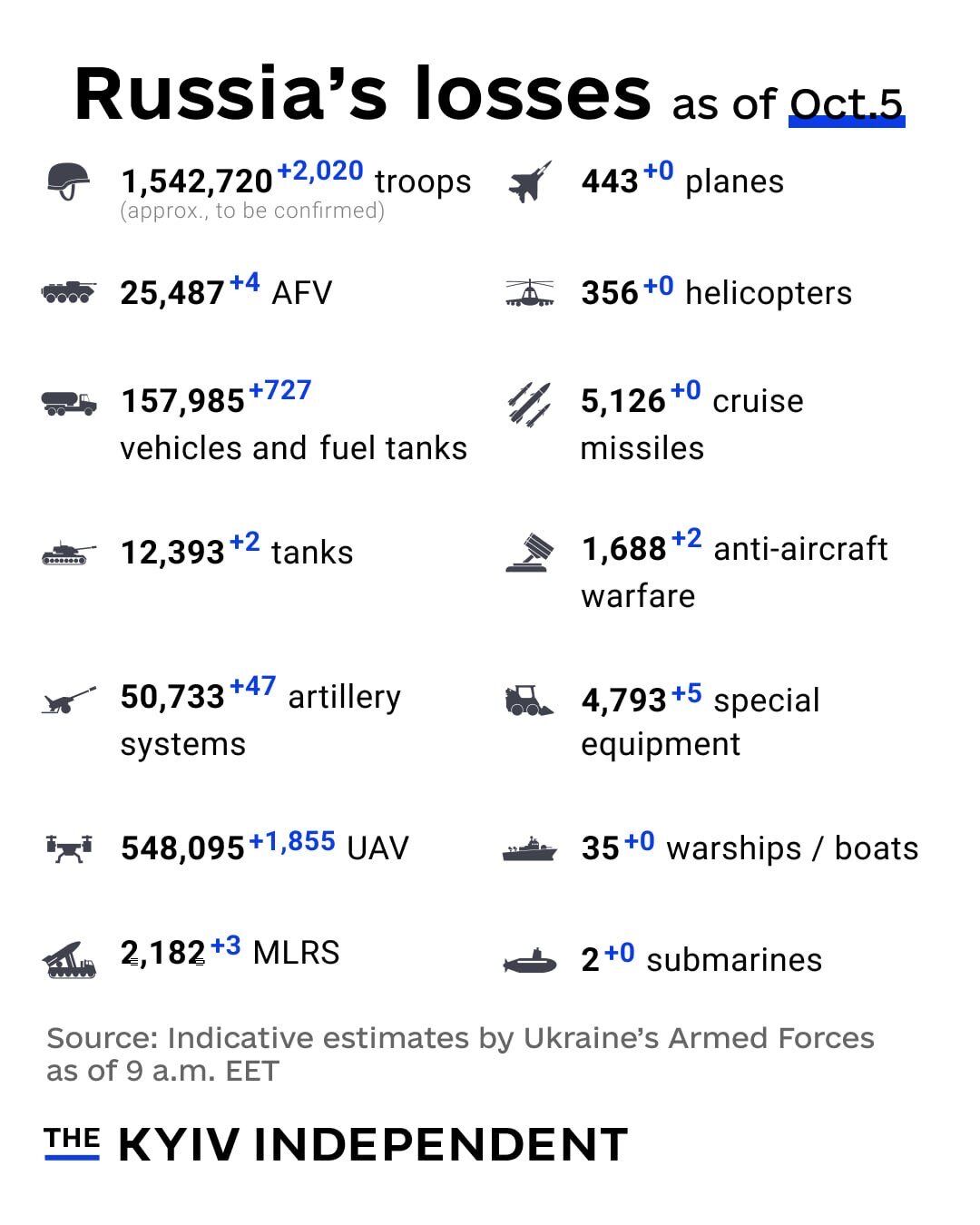 Pixelfeddnesnaukrajine (@[email protected])Aktualizované ztráty RuAF